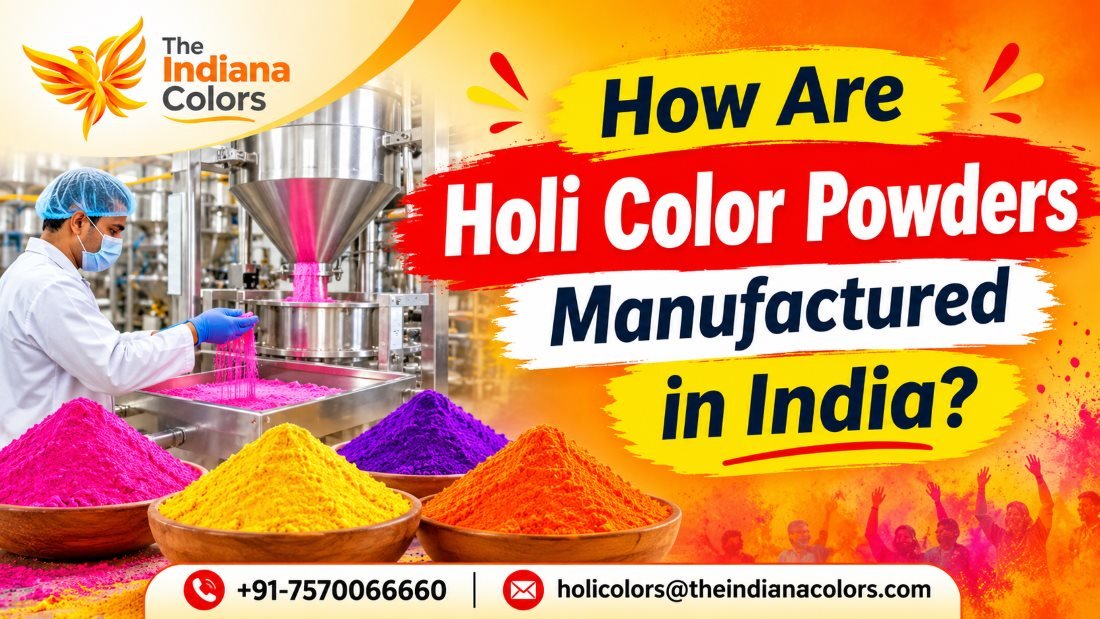
How Are Holi Color Powders Manufactured in India?
Holi color powders are an essential part of the festival of colors, but have you ever wondered how they are manufactured? Behind every batch of colored powder is a production process that involves raw material selection, color blending, processing, quality checks and packaging.
In India, Holi color powder manufacturing serves different requirements, including traditional Holi celebrations, commercial events, Color Run activities, wholesale distribution and international markets. Manufacturers produce different types of color powders depending on their intended use, product specifications and customer requirements.
Understanding the Holi color powder manufacturing process helps businesses, wholesalers, distributors and event organizers evaluate product quality, manufacturing capabilities and supply options before choosing a suitable manufacturer.
Quick Answer
Holi color powders are manufactured through a series of production steps that include raw material selection, ingredient preparation, blending, processing, sieving, quality inspection and packaging. The exact process depends on the type of color powder, its formulation and the manufacturer’s production methods.
Manufacturers select suitable ingredients, prepare the required color formulations, process the materials to achieve the desired texture and appearance, and check the finished product before packaging it for wholesale, retail or bulk distribution.
1. Raw Material Selection
The first stage of Holi color powder manufacturing is selecting suitable raw materials. The choice of ingredients depends on the product category, desired color, texture and intended application.
Manufacturers evaluate materials based on their suitability, consistency and applicable product safety requirements.
Some important considerations include:
- Quality and consistency of raw materials
- Desired color and powder texture
- Suitability for the intended application
- Compatibility of different ingredients
- Applicable safety and quality standards
For example, natural Holi color powders may contain plant-derived or other natural-origin ingredients, depending on their formulation. Herbal formulations may also include selected botanical ingredients. However, natural-origin and certified organic ingredients are not necessarily the same. Organic claims should be supported by appropriate certification or relevant documentation. Other Holi color formulations may use suitable color ingredients to achieve specific shades and product characteristics.
2. Color Formulation and Ingredient Preparation
After selecting the raw materials, manufacturers prepare the formulation according to the required product specifications.
This stage involves deciding the ingredient proportions, color shades and physical properties of the finished powder.
Different products may require different formulations, such as:
- Traditional Holi color powders
- Herbal and natural color powders
- Bright and vibrant festival colors
- Neon and UV-reactive color powders
- Color Run powders for organized events
Each category has its own requirements. Therefore, manufacturers need to select formulations according to the product’s intended use rather than following one standard formula for every type of color powder.
3. Mixing and Blending
Mixing and blending are important stages in the production process. During this step, selected ingredients are combined to achieve a consistent color and powder composition.
Manufacturers use suitable mixing equipment and production methods depending on the formulation and batch size.
Proper blending helps with:
- Consistent color distribution
- Uniform powder composition
- Reduced variation between batches
- Better control over the finished product
The mixing process is particularly important for manufacturers supplying Holi colors in bulk, where maintaining consistency across production batches is an important consideration.
4. Powder Processing and Sieving
Once the ingredients have been blended, the mixture may go through additional processing to achieve the required powder characteristics.
Processing and sieving methods depend on the formulation and manufacturing setup.
This stage may help manufacturers control:
- Powder fineness
- Particle size consistency
- Texture and flow properties
- Removal of unwanted larger particles
The objective is to prepare a finished powder that meets the specifications established for the particular product.
5. Quality Inspection and Testing
Quality inspection is an important part of Holi color powder manufacturing. Before products are approved for packaging, manufacturers should evaluate whether the finished batches meet the required specifications.
Depending on the product and applicable requirements, quality checks may include:
- Color consistency
- Powder texture and uniformity
- Raw material and batch traceability
- Relevant safety and quality testing
- Packaging condition and product identification
- Verification of product specifications against batch records
Maintaining batch records and documented quality checks helps manufacturers monitor product consistency and identify variations during production.
For products intended for festivals and public events, appropriate safety assessment is particularly important. Manufacturers should ensure that product claims are supported by relevant testing and documentation.
Terms such as herbal, organic, skin-friendly and non-toxic should only be used when they are justified by the product formulation and appropriate evidence.
6. Packaging and Labelling
After quality inspection, the finished Holi color powder is prepared for packaging.
Packaging requirements depend on the product type, order quantity, distribution method and customer preferences.
Common packaging requirements include:
- Small retail packs
- Bulk bags
- Wholesale packaging
- Custom-branded packaging
- Private-label packaging
Suitable packaging helps protect Holi color powders during storage, handling and transportation while maintaining product identification and supporting distribution requirements. Product labels may include relevant information such as product name, net quantity, manufacturer details, batch information and other applicable declarations.
Businesses ordering in bulk may also discuss customized packaging and branding requirements with the manufacturer.
7. Bulk Storage and Distribution
The final stage involves storing and preparing packaged products for distribution.
Holi color powders may be supplied to different types of customers, including:
- Wholesalers and distributors
- Retail businesses
- Event management companies
- Color Run organizers
- Festival suppliers
- International buyers
For bulk orders, manufacturers need to coordinate production quantities, packaging specifications and dispatch requirements according to the order.
A well-managed supply process helps businesses plan their inventory and prepare for seasonal demand during the Holi festival period.
What Should Businesses Check Before Choosing a Holi Color Powder Manufacturer?
Choosing a suitable Holi color powder manufacturer involves more than comparing prices. Businesses should evaluate production capabilities, product specifications and supply arrangements.
Here are some important factors to consider:
- Manufacturing Experience:– Understand the manufacturer’s experience with different categories of Holi color powders.
- Product Range:– Check whether the manufacturer offers the required colors, formulations and product varieties.
- Quality Control:– Understand how the manufacturer manages raw material inspection, production batch checks, finished product evaluation and relevant safety testing.
- Bulk Production Capacity:– Confirm whether the manufacturer can handle your required order quantity and delivery schedule.
- Packaging Options:– Check the availability of retail, wholesale, bulk and customized packaging.
- Documentation:– Review applicable product specifications, test reports and other relevant compliance documents.
- Communication and Supply Planning:– Discuss order timelines, dispatch arrangements and requirements for repeat orders.
These considerations can help businesses select a manufacturing partner according to their commercial and product requirements.
How The Indiana Colors Supports Holi Color Requirements
The Indiana Colors is a Holi color manufacturer and supplier in India, offering different color powder solutions for festival celebrations, commercial applications and organized events. Its product range caters to businesses looking for different color categories and bulk supply requirements.
Its product range includes traditional Holi color powders, herbal and organic color options, natural color powders, neon and UV colors and Color Run powders. The company also offers bulk supply, customized packaging and private-label solutions for businesses, wholesalers, distributors and event organizers.
Businesses interested in sourcing Holi color powders can discuss their required product categories, color options, order quantities and packaging preferences with the company to identify suitable supply solutions.
Businesses, wholesalers and event organizers looking for Holi color powder supply can contact The Indiana Colors to discuss product options, bulk order requirements and customized packaging solutions.
Key Takeaways
- Holi color powder manufacturing begins with selecting suitable raw materials.
- Different formulations are developed for traditional Holi colors, herbal and natural color powders and event-related applications.
- Blending and processing help achieve the required color, texture and consistency.
- Quality checks are important before products are packed and supplied.
- Packaging depends on the quantity, intended use and customer requirements.
- Manufacturers may provide bulk supply and private-label packaging solutions.
Final Thoughts
Holi color powder manufacturing involves several important stages, from raw material selection and formulation to blending, processing, quality inspection and packaging. Each stage contributes to the consistency and suitability of the finished product.
For businesses, wholesalers, distributors and event organizers, understanding this process makes it easier to evaluate manufacturers and select products that match their requirements.
The Indiana Colors provides Holi color powder solutions, bulk supply and customized packaging options for different business and event requirements. Choosing a manufacturer with suitable production capabilities and a clear quality-control process can help support reliable product sourcing.
Frequently Asked Questions
Holi color powders are manufactured through raw material selection, formulation, mixing, processing, sieving, quality inspection and packaging. The exact production method varies according to the product formulation and intended application.
The raw materials depend on the type of color powder. Manufacturers may use suitable base materials, color ingredients and other formulation components selected according to product specifications and applicable safety requirements.
Herbal Holi colors are produced using formulations that may include plant-derived or other natural-origin ingredients. The ingredients are selected, processed and blended according to the desired product characteristics.
Quality testing helps manufacturers evaluate color consistency, powder characteristics and applicable product safety requirements. It also helps verify whether finished products meet defined specifications and maintain consistency across production batches.
Yes. Manufacturers may produce Holi color powders in bulk for wholesalers, distributors, retailers, event organizers and commercial buyers, depending on their production capacity and order requirements.
Many manufacturers offer private-label services in which products are packed and branded according to a customer’s requirements. Available options depend on the manufacturer’s capabilities and order specifications.